Blog · Black holes
What is a black hole?
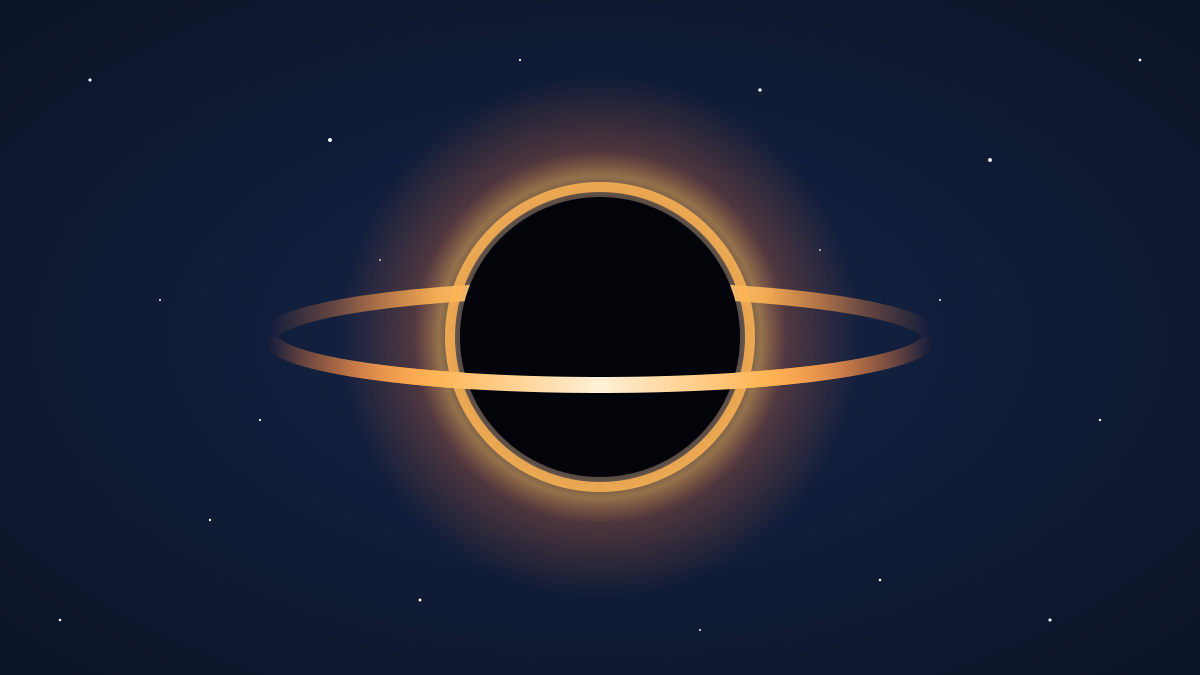
A black hole is a place in space where gravity pulls so hard that nothing can escape — not even light. It forms when a huge amount of stuff gets squeezed into a very tiny space.
First, what is gravity doing here?
Gravity is the pull that everything with mass has on everything else. It’s why a ball falls back down when you throw it up, and why the Moon keeps going around the Earth.
The more stuff (mass) is packed into something, and the smaller it is, the stronger the pull close to it. To escape Earth’s gravity, a rocket has to travel at about 11 km every second. That’s fast, but possible.
Now imagine squeezing something so hard that the speed needed to escape becomes faster than light. Light is the fastest thing in the universe. If even light can’t get out, nothing can. That is a black hole.
How does a black hole form?
Most black holes are born when a giant star dies. Stars are like huge balls of burning gas. For millions of years, the heat pushing outwards balances gravity pulling inwards.
When a very big star (many times heavier than our Sun) runs out of fuel, that balance breaks. Gravity wins. The star’s core collapses in on itself in less than a second, and the outer layers are blasted into space in a massive explosion called a supernova. What’s left behind can be a black hole.
An Indian scientist played a big part in this story. In the 1930s, Subrahmanyan Chandrasekhar worked out that dead stars above a certain weight can’t hold themselves up — an idea that pointed towards black holes. He later won the Nobel Prize in Physics in 1983.
Why is it “black”?
Because no light comes out of it, you can’t see a black hole directly. It just looks like a patch of perfect darkness.
But we can see what’s around it. Gas and dust swirling towards a black hole move so fast that they heat up and glow brightly. In 2019, scientists using a network of telescopes around the world released the first-ever photo of a black hole — a dark shadow surrounded by a glowing orange ring.
The “point of no return”
Every black hole has an invisible boundary around it called the event horizon. Think of it like the edge of a waterfall: far away, a boat can still paddle to safety. Once it crosses the edge, there’s no going back.
Outside the event horizon, things can still escape. Inside it, nothing can.
Is there one near us?
Yes, but it’s very far away, so don’t worry. At the centre of our galaxy, the Milky Way, sits a giant black hole called Sagittarius A* (say “Sagittarius A-star”). It is about 4 million times heavier than our Sun, and about 27,000 light-years away. Its photo was released in 2022.
If you could squeeze the entire Earth — every mountain, ocean and city — into a black hole, it would be smaller than a marble. About 2 centimetres across.
Frequently asked questions
Can a black hole swallow the Earth?
No. There is no black hole anywhere close enough to be a danger to us. And if the Sun were magically replaced by a black hole of the same weight, Earth would keep orbiting just as it does now — it would just get very cold and dark.
What happens if you fall into a black hole?
Near a small black hole, gravity pulls much harder on your feet than on your head, stretching you out like a noodle. Scientists really do call this “spaghettification”.
Are black holes holes?
Not really. A black hole isn’t an empty hole — it’s the opposite. It is an enormous amount of matter packed into a tiny space. The “hole” part just means that things go in and don’t come out.
How do scientists find black holes if they’re invisible?
They look for clues: stars zooming around something they can’t see, glowing hot gas, and tiny ripples in space called gravitational waves that are created when two black holes crash into each other.
Sources
Last updated: