Blog · Planets
Why is Mars red?
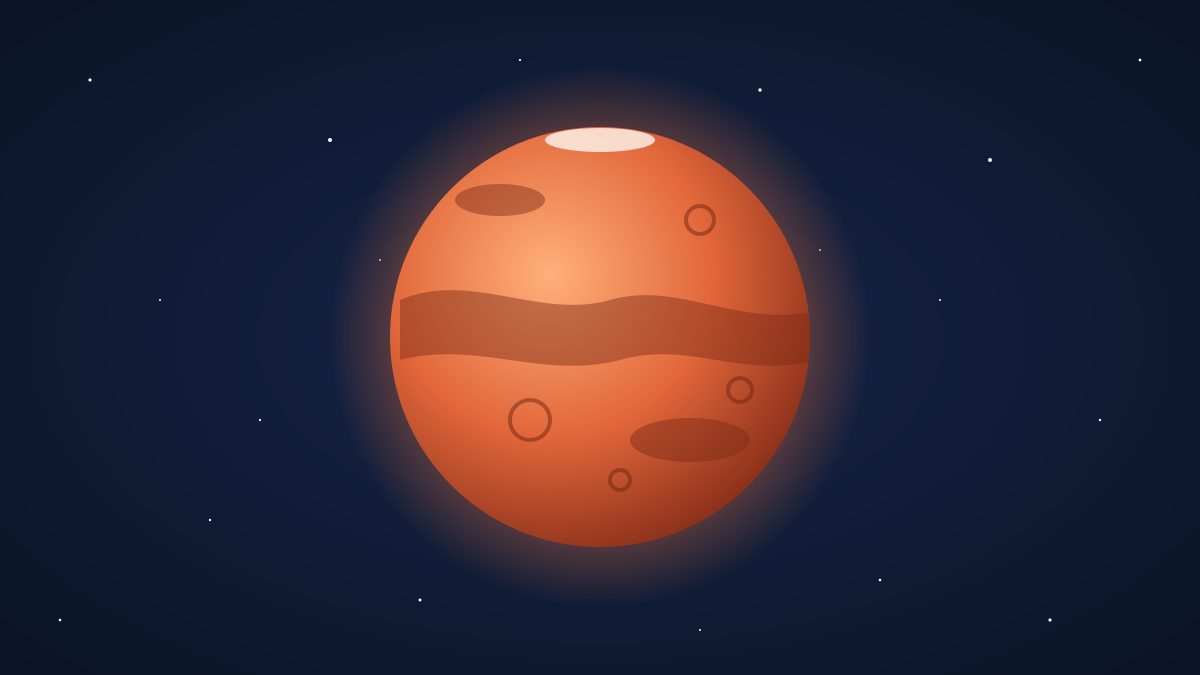
Mars is red because its surface is covered in dust and rocks containing rusty iron. It’s the same thing that makes an old bicycle or a forgotten iron nail turn reddish-brown.
Rust, but on a whole planet
You’ve probably seen rust. When iron meets oxygen (usually with a little help from water), it slowly turns into a reddish-brown material. Scientists call it iron oxide.
Mars has a lot of iron in its rocks. Over billions of years, that iron reacted with oxygen and turned rusty. The rocks then broke down into a very fine dust, as fine as talcum powder, which now covers much of the planet.
So when you look at Mars, you’re looking at a planet coated in rust-coloured dust.
Wind spreads the colour everywhere
Mars has strong winds. They pick up the fine red dust and carry it all over the planet. Sometimes the storms grow so big that they cover almost the whole of Mars for weeks.
Dust also floats high up in the thin Martian air. That’s why the sky on Mars often looks a pale butterscotch or pinkish colour during the day, instead of blue like ours.
Is Mars red all the way through?
No. The red colour is mostly a thin coating on the surface. When NASA’s rovers have scratched or drilled into Martian rocks, the powder underneath is often grey. Mars is a bit like a jalebi: the outside colour doesn’t tell you everything about what’s inside.
You can see it yourself
Mars is one of the easiest planets to spot in the night sky, even from a city. Look for a bright “star” that doesn’t twinkle much and has a clear orange-red tint. That’s the rust you’re seeing, from millions of kilometres away.
India has been there too
In 2014, India’s Mangalyaan (the Mars Orbiter Mission) reached Mars orbit. India became the first Asian country to reach Mars orbit, and the first country in the world to do it on its very first try.
On Mars, sunsets are blue. The fine Martian dust lets blue light through towards the Sun’s direction, so the sky around the setting Sun glows blue, which is the opposite of Earth.
Frequently asked questions
Is Mars hot because it’s red?
No. The red colour is only rust. Mars is actually very cold. It’s farther from the Sun than Earth and has a thin atmosphere that can’t hold on to heat. On average it’s well below freezing.
Is there water on Mars?
Today, most of Mars’s water is frozen as ice, especially at its poles and under the ground. Long ago, scientists believe rivers and lakes flowed on its surface.
How long is a day on Mars?
Almost the same as ours: about 24 hours and 37 minutes. But a year on Mars is much longer, about 687 Earth days, because Mars takes longer to go around the Sun.
How big is Mars compared to Earth?
Mars is about half as wide as Earth. You could fit about six Mars-sized planets inside Earth.
Sources
Last updated: